 NASA (Exoplanet Catalog artwork)
HIP 65426 b
The first exoplanet directly imaged by JWST
Overview
HIP 65426 b, also named Najsakopajk, is a super-Jupiter exoplanet orbiting the star HIP 65426. It was discovered on 6 July 2017 by the SPHERE consortium using the Spectro-Polarimetric High-Contrast Exoplanet Research (SPHERE) instrument belonging to the European Southern Observatory (ESO), being the first confirmed planet discovered by the SPHERE instrument. It is 351 light-years from Earth in the constellation Centaurus.
Source: Wikipedia
NASA: HIP 65426 b is a gas giant exoplanet that orbits a A-type star. Its mass is 9 Jupiters, it takes 630.7 years to complete one orbit of its star, and is 92 AU from its star. Its discovery was announced in 2017.
Why it matters
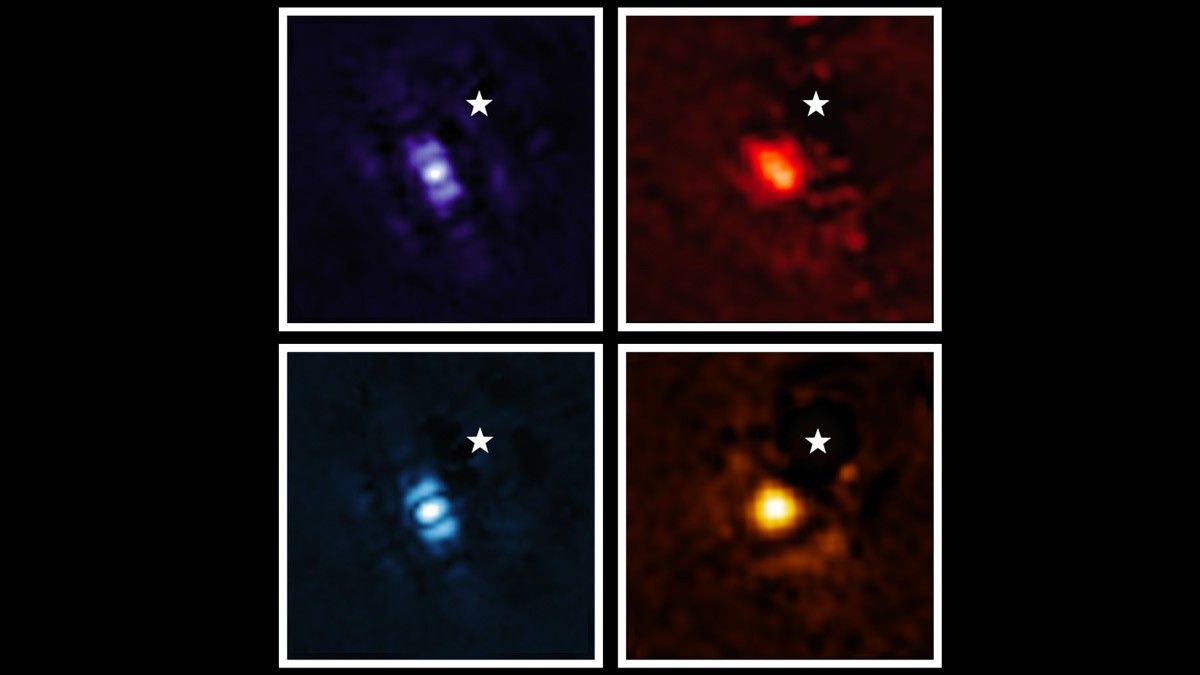
- JWST photographed it in 2022 at infrared wavelengths no ground telescope could reach.
- A roughly 7-Jupiter-mass planet about 100 AU from a young star 385 light-years away.
- Showed JWST could image planets fainter than expected, opening the door to smaller worlds.
NASA puts it this way: “HIP 65426 b is a gas giant exoplanet that orbits an A-type star. Its mass is 9 Jupiters, it takes 630.7 years to complete one orbit of its star, and is 92 AU from its star. Its discovery was announced in 2017. NASA's James Webb Space Telescope was used to directly image the planet in 2022.”
Discovery & system
- Discovered
- 2017 · Imaging · Paranal Observatory
- Discovery paper
- Chauvin et al. 2017
- Discoverers
- Max Planck Institute for Astronomy
- Host star
- HIP 65426 · A2 V · 8,840 K · 1.96 M☉
- System
- 1 known planet
The system
| World | Period | Distance | Radius | Mass | Temp. |
|---|---|---|---|---|---|
| HIP 65426 b | 630.3 yr | 92 AU | 1.5 R♃ | 9 M♃ | 1,500 K |
By the numbers
- Radius
- 1.5 R♃16.8 R⊕
- Mass
- 9 M♃2,860 M⊕
- Distance from star
- 92 AU13,763 million km
- Equilibrium temp.
- 1,500 K1,227 °C
- Starlight received
- 0 × Earth
- Distance from Earth
- 355 ly108.9 pc
- Density
- 3.31 g/cm³0.6 × Earth
Sources
Image: NASA (Exoplanet Catalog artwork) · NASA media: generally free of copyright · image page
Text: Wikipedia (CC BY-SA 4.0). Taglines and highlights are editorial.