 NASA (Exoplanet Catalog artwork)
Najsakopajk
HIP 65426 bDer erste vom JWST direkt abgebildete Exoplanet
Überblick
HIP 65426 b, also named Najsakopajk, is a super-Jupiter exoplanet orbiting the star HIP 65426. It was discovered on 6 July 2017 by the SPHERE consortium using the Spectro-Polarimetric High-Contrast Exoplanet Research (SPHERE) instrument belonging to the European Southern Observatory (ESO), being the first confirmed planet discovered by the SPHERE instrument. It is 351 light-years from Earth in the constellation Centaurus.
Quelle: Wikipedia · Diese Beschreibung ist nur auf Englisch verfügbar.
NASA: HIP 65426 b is a gas giant exoplanet that orbits a A-type star. Its mass is 9 Jupiters, it takes 630.7 years to complete one orbit of its star, and is 92 AU from its star. Its discovery was announced in 2017.
Warum sie zählt
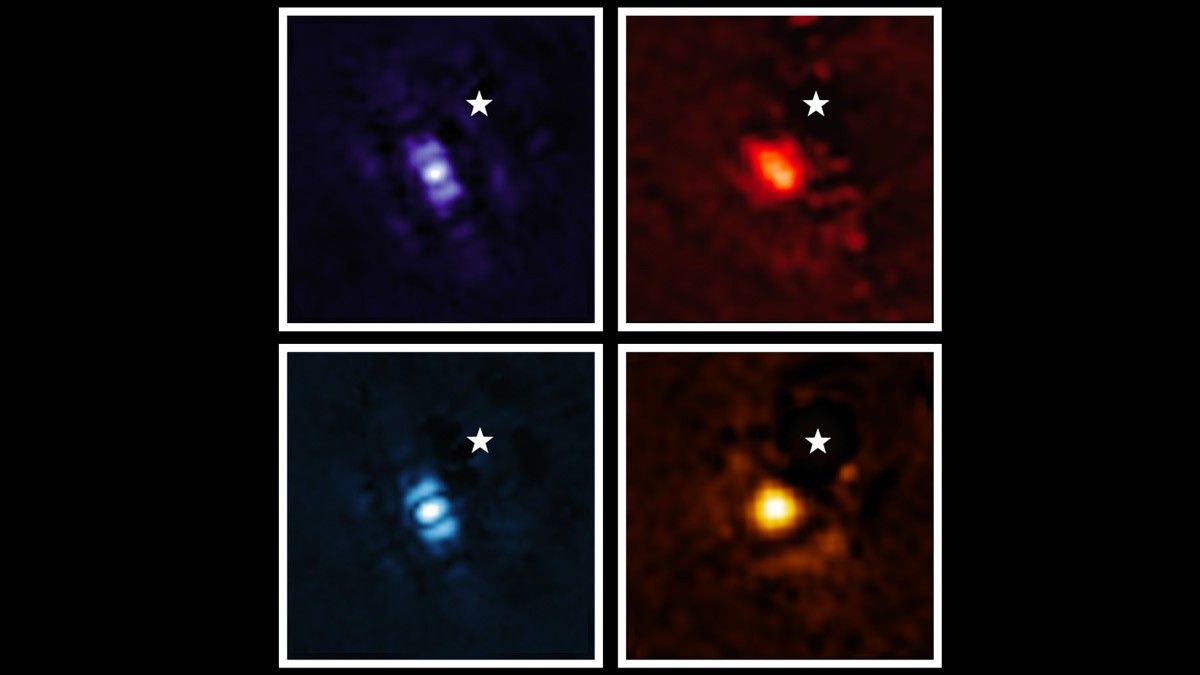
- JWST fotografierte ihn 2022 bei Infrarotwellenlängen, die kein Bodenteleskop erreichen kann.
- Ein Planet von rund 7 Jupitermassen etwa 100 AE von einem jungen Stern 385 Lichtjahre entfernt.
- Zeigte, dass das JWST schwächere Planeten abbilden kann als erwartet, und öffnete die Tür zu kleineren Welten.
Die NASA formuliert es so: „HIP 65426 b is a gas giant exoplanet that orbits an A-type star. Its mass is 9 Jupiters, it takes 630.7 years to complete one orbit of its star, and is 92 AU from its star. Its discovery was announced in 2017. NASA's James Webb Space Telescope was used to directly image the planet in 2022.“
Entdeckung & System
- Entdeckt
- 2017 · Imaging · Paranal Observatory
- Entdeckungsarbeit
- Chauvin et al. 2017
- Entdecker
- Max Planck Institute for Astronomy
- Zentralstern
- HIP 65426 · A2 V · 8.840 K · 1,96 M☉
- System
- 1 bekannter Planet
Das System
| Welt | Periode | Abstand | Radius | Masse | Temp. |
|---|---|---|---|---|---|
| HIP 65426 b | 630,3 Jahre | 92 AE | 1,5 R♃ | 9 M♃ | 1.500 K |
In Zahlen
- Radius
- 1,5 R♃16,8 R⊕
- Masse
- 9 M♃2.860 M⊕
- Abstand zum Stern
- 92 AE13.763 Mio. km
- Gleichgewichtstemp.
- 1.500 K1.227 °C
- Empfangenes Sternlicht
- 0 × Erde
- Entfernung zur Erde
- 355 Lj108,9 pc
- Dichte
- 3,31 g/cm³0,6 × Erde
Quellen
Bild: NASA (Exoplanet Catalog artwork) · NASA media: generally free of copyright · Bildseite
Text: Wikipedia (CC BY-SA 4.0). Schlagzeilen und Highlights sind redaktionell.