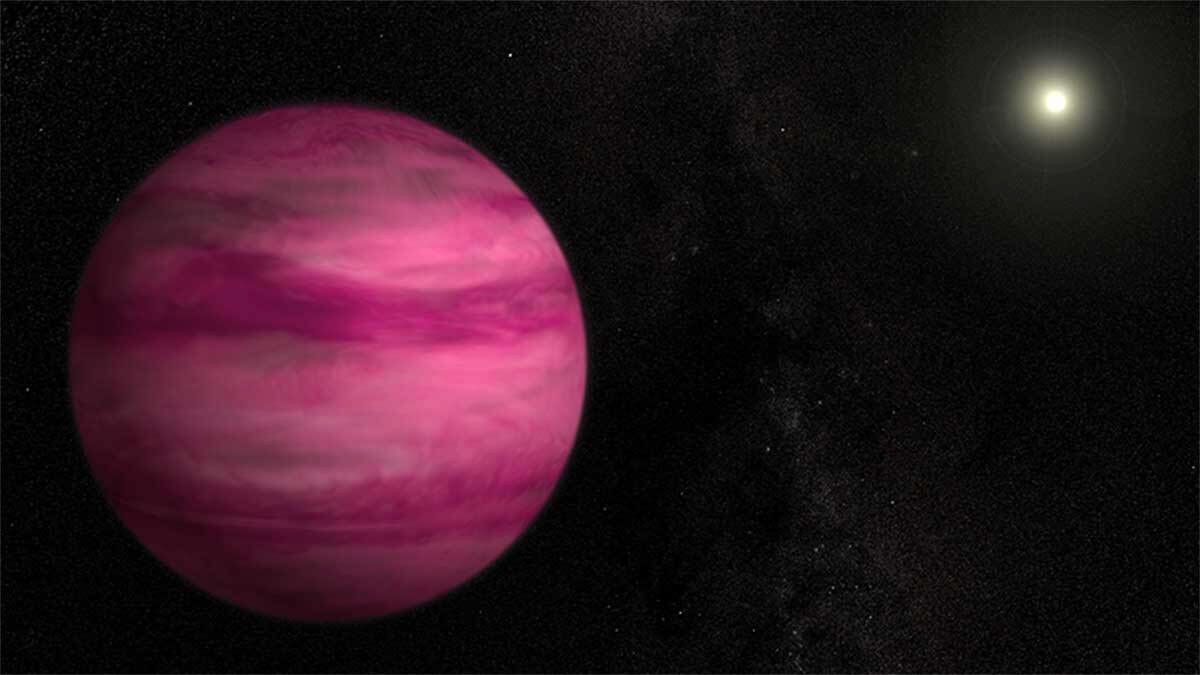
 NASA (Exoplanet Catalog artwork)
Gliese 504 b
The 'pink planet': a young giant still glowing magenta from its formation
Overview
Gliese 504 b is a jovian planet or a brown dwarf orbiting the solar analog 59 Virginis, discovered by direct imaging using HiCIAO instrument and AO188 adaptive optics system on the Subaru Telescope of Mauna Kea Observatory, Hawaii by Kuzuhara et al.
Source: Wikipedia
NASA: GJ 504 b is a gas giant exoplanet that orbits a F-type star. Its mass is 4 Jupiters, it takes 259.9 years to complete one orbit of its star, and is 43.5 AU from its star. Its discovery was announced in 2013.
Why it matters
- Imaged by the Subaru telescope in 2013 around a Sun-like star 57 light-years away.
- Orbits about 44 AU out, farther than Neptune; its mass may place it near the brown-dwarf boundary.
- The coolest directly imaged planet-mass object at the time, around 240 °C.
NASA puts it this way: “If we could travel to this giant planet, we would see a world still glowing from the heat of its formation with a color reminiscent of a dark cherry blossom, a dull magenta.”
Discovery & system
- Discovered
- 2013 · Imaging · Subaru Telescope
- Discovery paper
- Kuzuhara et al. 2013
- Discoverers
- Maunakea Observatories
- Host star
- GJ 504 · G0 V · 6,234 K · 1.22 M☉
- System
- 1 known planet
The system
| World | Period | Distance | Radius | Mass | Temp. |
|---|---|---|---|---|---|
| GJ 504 b | 259.7 yr | 43.5 AU | 1.08 R♃ | 4 M♃ | 510 K |
By the numbers
- Radius
- 1.08 R♃12.1 R⊕
- Mass
- 4 M♃1,271 M⊕
- Distance from star
- 43.5 AU6,508 million km
- Equilibrium temp.
- 510 K237 °C
- Starlight received
- 0 × Earth
- Distance from Earth
- 57.2 ly17.5 pc
- Density
- 3.94 g/cm³0.72 × Earth
Sources
Image: NASA (Exoplanet Catalog artwork) · NASA media: generally free of copyright · image page
Text: Wikipedia (CC BY-SA 4.0). Taglines and highlights are editorial.