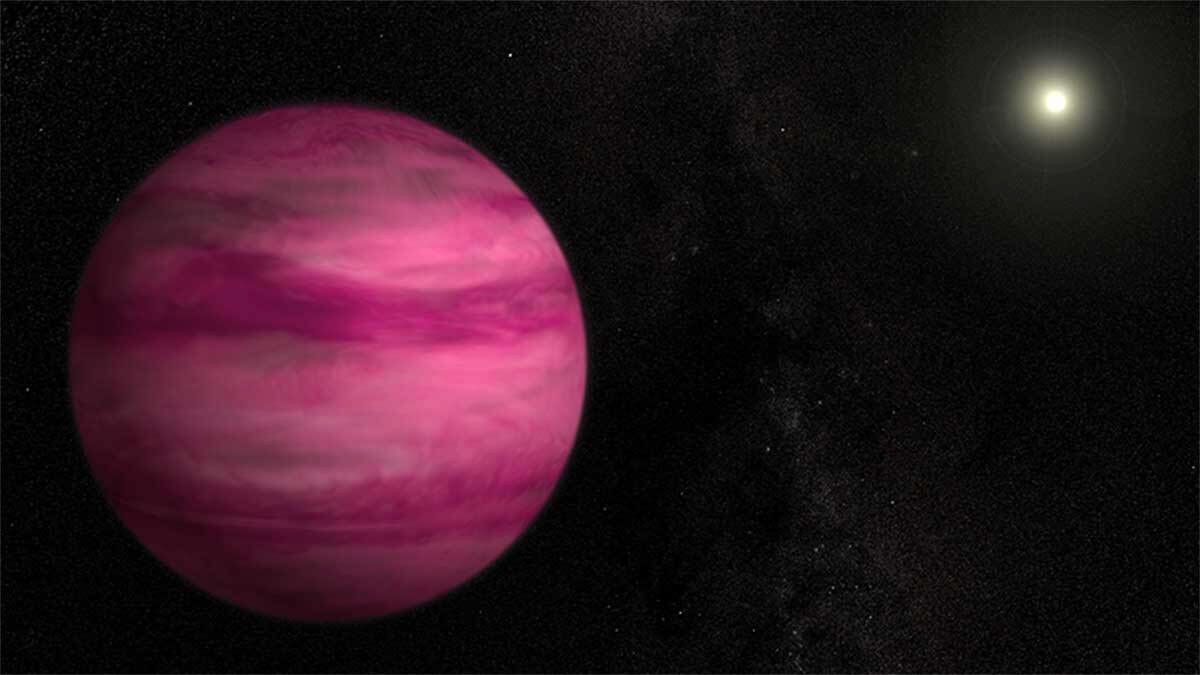
 NASA (Exoplanet Catalog artwork)
Gliese 504 b
Der „rosa Planet“: ein junger Riese, der noch magentafarben von seiner Entstehung glüht
Überblick
Gliese 504 b is a jovian planet or a brown dwarf orbiting the solar analog 59 Virginis, discovered by direct imaging using HiCIAO instrument and AO188 adaptive optics system on the Subaru Telescope of Mauna Kea Observatory, Hawaii by Kuzuhara et al.
Quelle: Wikipedia · Diese Beschreibung ist nur auf Englisch verfügbar.
NASA: GJ 504 b is a gas giant exoplanet that orbits a F-type star. Its mass is 4 Jupiters, it takes 259.9 years to complete one orbit of its star, and is 43.5 AU from its star. Its discovery was announced in 2013.
Warum sie zählt
- 2013 vom Subaru-Teleskop um einen sonnenähnlichen Stern 57 Lichtjahre entfernt abgebildet.
- Umläuft in etwa 44 AE, weiter draußen als Neptun; seine Masse könnte ihn an die Grenze zum Braunen Zwerg rücken.
- Damals das kühlste direkt abgebildete Objekt planetarer Masse, um 240 °C.
Die NASA formuliert es so: „If we could travel to this giant planet, we would see a world still glowing from the heat of its formation with a color reminiscent of a dark cherry blossom, a dull magenta.“
Entdeckung & System
- Entdeckt
- 2013 · Imaging · Subaru Telescope
- Entdeckungsarbeit
- Kuzuhara et al. 2013
- Entdecker
- Maunakea Observatories
- Zentralstern
- GJ 504 · G0 V · 6.234 K · 1,22 M☉
- System
- 1 bekannter Planet
Das System
| Welt | Periode | Abstand | Radius | Masse | Temp. |
|---|---|---|---|---|---|
| GJ 504 b | 259,7 Jahre | 43,5 AE | 1,08 R♃ | 4 M♃ | 510 K |
In Zahlen
- Radius
- 1,08 R♃12,1 R⊕
- Masse
- 4 M♃1.271 M⊕
- Abstand zum Stern
- 43,5 AE6.508 Mio. km
- Gleichgewichtstemp.
- 510 K237 °C
- Empfangenes Sternlicht
- 0 × Erde
- Entfernung zur Erde
- 57,2 Lj17,5 pc
- Dichte
- 3,94 g/cm³0,72 × Erde
Quellen
Bild: NASA (Exoplanet Catalog artwork) · NASA media: generally free of copyright · Bildseite
Text: Wikipedia (CC BY-SA 4.0). Schlagzeilen und Highlights sind redaktionell.