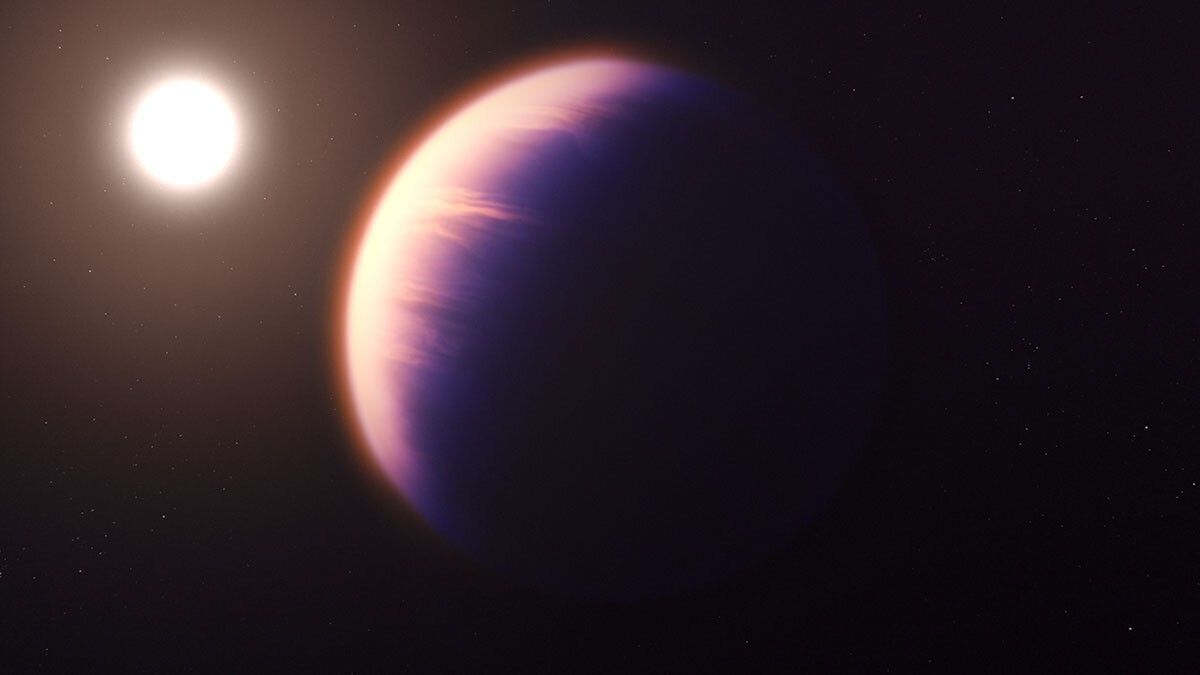
 NASA (Exoplanet Catalog artwork)
WASP-39b
auch Bocaprins genanntDas Vorzeigeobjekt des JWST: erster klarer CO2-Nachweis und erste Photochemie auf einem Exoplaneten
Überblick
WASP-39b, officially named Bocaprins, is a hot Jupiter extrasolar planet discovered in February 2011 by the WASP project, notable for containing a substantial amount of water in its atmosphere. In addition Bocaprins was the first exoplanet found to contain carbon dioxide in its atmosphere, and likewise for sulfur dioxide.
Quelle: Wikipedia · Diese Beschreibung ist nur auf Englisch verfügbar.
NASA: WASP-39 b is a gas giant exoplanet that orbits a G-type star. Its mass is 0.281 Jupiters, it takes 4.1 days to complete one orbit of its star, and is 0.04828 AU from its star. Its discovery was announced in 2011. In July 2022 it became the first exoplanet to be studied by NASA’s James Webb Space Telescope.
Warum sie zählt
- JWST meldete 2022 eindeutiges Kohlendioxid in seiner Atmosphäre.
- Schwefeldioxid, durch sternlichtgetriebene Chemie erzeugt, wurde gefunden – die erste Photochemie auf einem Exoplaneten.
- Ein aufgeblähter heißer Saturn etwa 700 Lichtjahre entfernt mit einer 4-Tage-Bahn.
Die NASA formuliert es so: „_WASP-39 b is a gas giant exoplanet that orbits a G-type star. Its mass is 0.28 Jupiters, it takes 4.1 days to complete one orbit of its star, and is 0.0486 AU from its star. Its discovery was announced in 2011. In July 2022 it became the first exoplanet to be studied by NASA's James Webb Space Telescope.“
Entdeckung & System
- Entdeckt
- 2011 · Transit · SuperWASP
- Entdeckungsarbeit
- Faedi et al. 2011
- Zentralstern
- WASP-39 · 5.485 K · 0,91 M☉
- System
- 1 bekannter Planet
Das System
| Welt | Periode | Abstand | Radius | Masse | Temp. |
|---|---|---|---|---|---|
| WASP-39 b | 4,06 d | 0,048 AE | 1,28 R♃ | 89,31 M⊕ | 1.166 K |
In Zahlen
- Radius
- 1,28 R♃14,3 R⊕
- Masse
- 89,31 M⊕533,38 ×10²⁴ kg
- Umlaufzeit
- 4,06 d0,01 Jahre
- Abstand zum Stern
- 0,048 AE7,22 Mio. km
- Exzentrizität
- 0nahezu kreisförmig
- Gleichgewichtstemp.
- 1.166 K893 °C
- Empfangenes Sternlicht
- 316 × Erde
- Entfernung zur Erde
- 698 Lj214 pc
- Dichte
- 0,17 g/cm³0,03 × Erde
Quellen
Bild: NASA (Exoplanet Catalog artwork) · NASA media: generally free of copyright · Bildseite
Text: Wikipedia (CC BY-SA 4.0). Schlagzeilen und Highlights sind redaktionell.