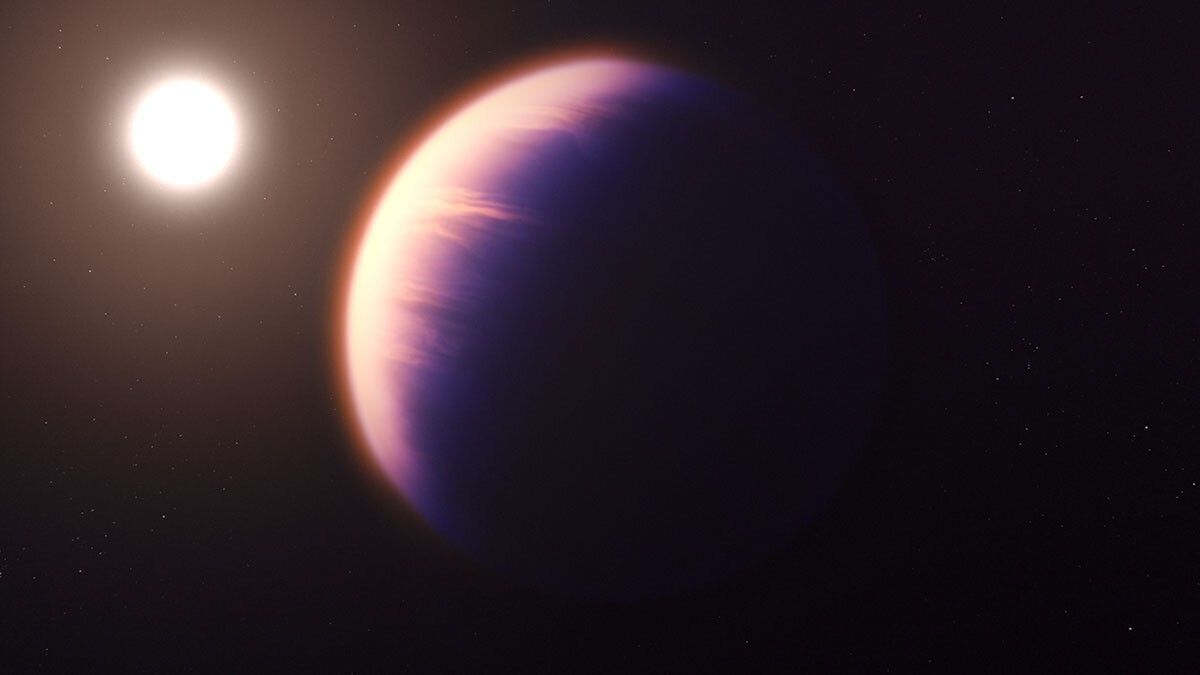
 NASA (Exoplanet Catalog artwork)
WASP-39b
also named BocaprinsJWST's showcase planet: first clear CO2 detection and first exoplanet photochemistry
Overview
WASP-39b, officially named Bocaprins, is a hot Jupiter extrasolar planet discovered in February 2011 by the WASP project, notable for containing a substantial amount of water in its atmosphere. In addition Bocaprins was the first exoplanet found to contain carbon dioxide in its atmosphere, and likewise for sulfur dioxide.
Source: Wikipedia
NASA: WASP-39 b is a gas giant exoplanet that orbits a G-type star. Its mass is 0.281 Jupiters, it takes 4.1 days to complete one orbit of its star, and is 0.04828 AU from its star. Its discovery was announced in 2011. In July 2022 it became the first exoplanet to be studied by NASA’s James Webb Space Telescope.
Why it matters
- JWST reported unambiguous carbon dioxide in its atmosphere in 2022.
- Sulfur dioxide produced by starlight-driven chemistry was found — the first photochemistry on an exoplanet.
- A puffy hot Saturn about 700 light-years away with a 4-day orbit.
NASA puts it this way: “_WASP-39 b is a gas giant exoplanet that orbits a G-type star. Its mass is 0.28 Jupiters, it takes 4.1 days to complete one orbit of its star, and is 0.0486 AU from its star. Its discovery was announced in 2011. In July 2022 it became the first exoplanet to be studied by NASA's James Webb Space Telescope.”
Discovery & system
- Discovered
- 2011 · Transit · SuperWASP
- Discovery paper
- Faedi et al. 2011
- Host star
- WASP-39 · 5,485 K · 0.91 M☉
- System
- 1 known planet
The system
| World | Period | Distance | Radius | Mass | Temp. |
|---|---|---|---|---|---|
| WASP-39 b | 4.06 d | 0.048 AU | 1.28 R♃ | 89.31 M⊕ | 1,166 K |
By the numbers
- Radius
- 1.28 R♃14.3 R⊕
- Mass
- 89.31 M⊕533.38 ×10²⁴ kg
- Orbital period
- 4.06 d0.01 yr
- Distance from star
- 0.048 AU7.22 million km
- Eccentricity
- 0nearly circular
- Equilibrium temp.
- 1,166 K893 °C
- Starlight received
- 316 × Earth
- Distance from Earth
- 698 ly214 pc
- Density
- 0.17 g/cm³0.03 × Earth
Sources
Image: NASA (Exoplanet Catalog artwork) · NASA media: generally free of copyright · image page
Text: Wikipedia (CC BY-SA 4.0). Taglines and highlights are editorial.