 NASA (Exoplanet Catalog artwork)
WASP-96b
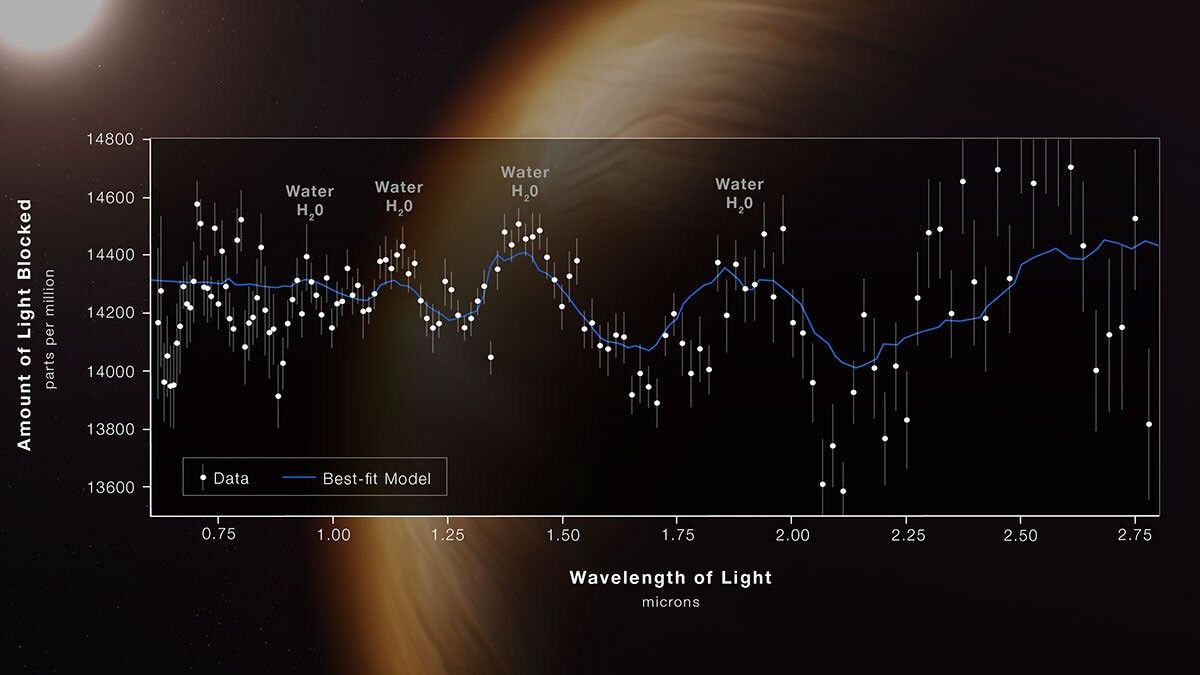
Der Planet hinter dem ersten veröffentlichten Exoplaneten-Spektrum des JWST
Überblick
WASP-96b is a gas giant exoplanet. Its mass is 0.48 times that of Jupiter. It is 0.0453 AU from the class G star WASP-96, which it orbits every 3.4 days. It is about 1,140 light-years away from Earth, in the constellation Phoenix. It was discovered in 2013 by the Wide Angle Search for Planets (WASP).
Quelle: Wikipedia · Diese Beschreibung ist nur auf Englisch verfügbar.
NASA: WASP-96 b is a gas giant exoplanet that orbits a G-type star. Its mass is 0.48 Jupiters, it takes 3.4 days to complete one orbit of its star, and is 0.0453 AU from its star. Its discovery was announced in 2014.
Warum sie zählt
- Sein Wasserdampfspektrum gehörte zu den ersten Wissenschaftsbildern des JWST, veröffentlicht im Juli 2022.
- Frühere VLT-Daten deuteten auf eine wolkenfreie Atmosphäre mit starker Natriumsignatur hin.
- Ein heißer, aufgeblähter Planet von Saturnmasse etwa 1 150 Lichtjahre entfernt.
Die NASA formuliert es so: „An international team found that WASP-96b is a world with a sodium rich atmosphere. The planet, located nearly 1,150 light-years from Earth, orbits its star every 3.4 days. It has about half the mass of Jupiter, and its discovery was announced in 2014. “
Entdeckung & System
- Entdeckt
- 2014 · Transit · SuperWASP
- Entdeckungsarbeit
- Hellier et al. 2014
- Zentralstern
- WASP-96 · G8 · 5.540 K · 1,06 M☉
- System
- 1 bekannter Planet
Das System
| Welt | Periode | Abstand | Radius | Masse | Temp. |
|---|---|---|---|---|---|
| WASP-96 b | 3,43 d | 0,045 AE | 1,2 R♃ | 0,48 M♃ | 1.285 K |
In Zahlen
- Radius
- 1,2 R♃13,5 R⊕
- Masse
- 0,48 M♃153 M⊕
- Umlaufzeit
- 3,43 d0,01 Jahre
- Abstand zum Stern
- 0,045 AE6,78 Mio. km
- Exzentrizität
- 0nahezu kreisförmig
- Gleichgewichtstemp.
- 1.285 K1.012 °C
- Empfangenes Sternlicht
- 517 × Erde
- Entfernung zur Erde
- 1.150 Lj352,5 pc
- Dichte
- 0,37 g/cm³0,07 × Erde
Quellen
Bild: NASA (Exoplanet Catalog artwork) · NASA media: generally free of copyright · Bildseite
Text: Wikipedia (CC BY-SA 4.0). Schlagzeilen und Highlights sind redaktionell.