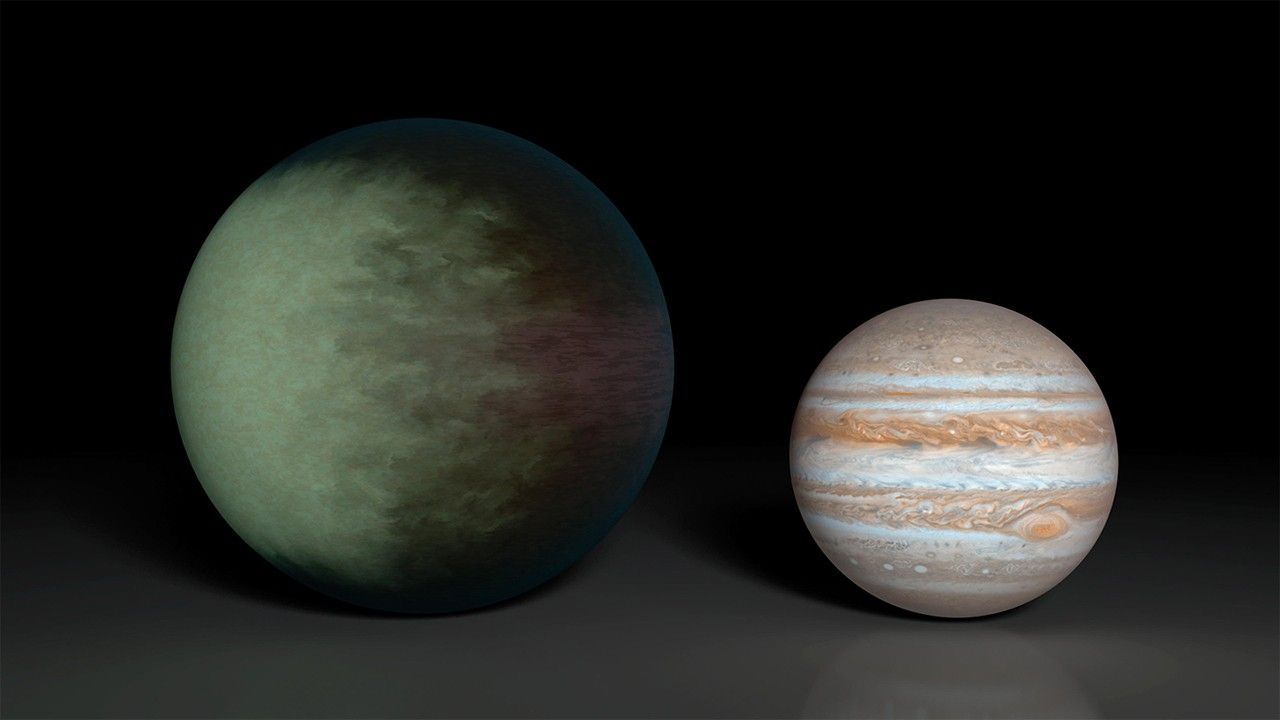
 NASA (Exoplanet Catalog artwork)
Kepler-7b
The first exoplanet to have its clouds mapped
Overview
Kepler-7b is one of the first five exoplanets to be confirmed by NASA's Kepler spacecraft, and was confirmed during the first 34 days of Kepler's science operations. It orbits a star slightly hotter and significantly larger than the Sun that is expected to soon reach the end of the main sequence. Kepler-7b is a hot Jupiter that is about half the mass of Jupiter, but is nearly 1.5 times its size; at the time of its discovery, Kepler-7b was the second most diffuse planet known, surpassed only by WASP-17b. It orbits its host star every five days at a distance of approximately 0.06 AU. Kepler-7b was announced at a meeting of the American Astronomical Society on January 4, 2010. It is the first extrasolar planet to have a crude map of cloud coverage.
Source: Wikipedia
NASA: Kepler-7 b is a gas giant exoplanet that orbits a G-type star. Its mass is 0.441 Jupiters, it takes 4.9 days to complete one orbit of its star, and is 0.06067 AU from its star. Its discovery was announced in 2009.
Why it matters
- Kepler and Spitzer data in 2013 showed clouds concentrated on its western hemisphere.
- Half as dense as Saturn — one of the puffiest planets known when discovered in 2009.
- High-altitude clouds give it a relatively high reflectivity for a hot Jupiter.
NASA puts it this way: “A massive world called a hot Jupiter, Kepler-7b was the first exoplanet to have its clouds mapped. ”
Discovery & system
- Discovered
- 2009 · Transit · Kepler
- Discovery paper
- Latham et al. 2010
- Discoverers
- Kepler Space Telescope
- Host star
- Kepler-7 · 5,933 K · 1.36 M☉
- System
- 1 known planet
The system
| World | Period | Distance | Radius | Mass | Temp. |
|---|---|---|---|---|---|
| Kepler-7 b | 4.89 d | 0.061 AU | 1.62 R♃ | 0.44 M♃ | 1,630 K |
By the numbers
- Radius
- 1.62 R♃18.2 R⊕
- Mass
- 0.44 M♃140 M⊕
- Orbital period
- 4.89 d0.01 yr
- Distance from star
- 0.061 AU9.08 million km
- Eccentricity
- 0nearly circular
- Equilibrium temp.
- 1,630 K1,357 °C
- Starlight received
- 1,375 × Earth
- Distance from Earth
- 3,009 ly922.6 pc
- Density
- 0.14 g/cm³0.03 × Earth
Sources
Image: NASA (Exoplanet Catalog artwork) · NASA media: generally free of copyright · image page
Text: Wikipedia (CC BY-SA 4.0). Taglines and highlights are editorial.