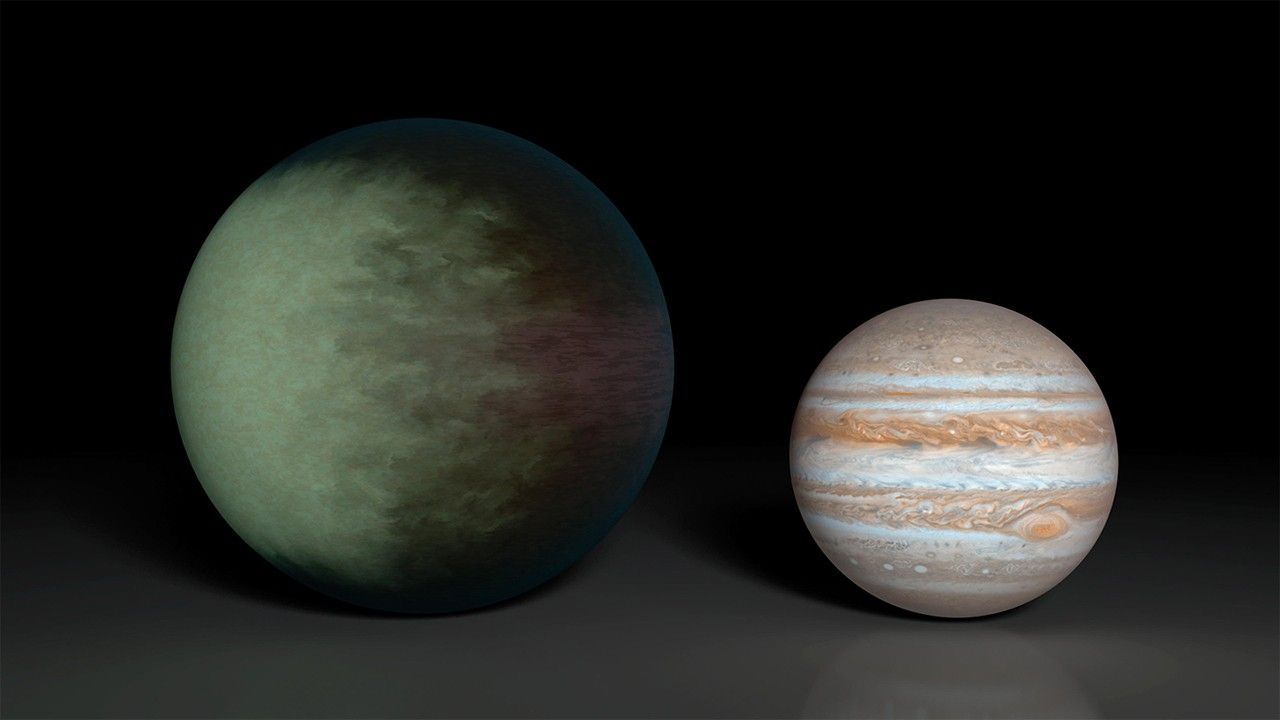
 NASA (Exoplanet Catalog artwork)
Kepler-7b
Der erste Exoplanet, dessen Wolken kartiert wurden
Überblick
Kepler-7b is one of the first five exoplanets to be confirmed by NASA's Kepler spacecraft, and was confirmed during the first 34 days of Kepler's science operations. It orbits a star slightly hotter and significantly larger than the Sun that is expected to soon reach the end of the main sequence. Kepler-7b is a hot Jupiter that is about half the mass of Jupiter, but is nearly 1.5 times its size; at the time of its discovery, Kepler-7b was the second most diffuse planet known, surpassed only by WASP-17b. It orbits its host star every five days at a distance of approximately 0.06 AU. Kepler-7b was announced at a meeting of the American Astronomical Society on January 4, 2010. It is the first extrasolar planet to have a crude map of cloud coverage.
Quelle: Wikipedia · Diese Beschreibung ist nur auf Englisch verfügbar.
NASA: Kepler-7 b is a gas giant exoplanet that orbits a G-type star. Its mass is 0.441 Jupiters, it takes 4.9 days to complete one orbit of its star, and is 0.06067 AU from its star. Its discovery was announced in 2009.
Warum sie zählt
- Kepler- und Spitzer-Daten zeigten 2013 Wolken, die sich auf seiner westlichen Hemisphäre konzentrieren.
- Halb so dicht wie Saturn – bei seiner Entdeckung 2009 einer der aufgeblähtesten bekannten Planeten.
- Hohe Wolken verleihen ihm für einen heißen Jupiter ein vergleichsweise hohes Rückstrahlvermögen.
Die NASA formuliert es so: „A massive world called a hot Jupiter, Kepler-7b was the first exoplanet to have its clouds mapped. “
Entdeckung & System
- Entdeckt
- 2009 · Transit · Kepler
- Entdeckungsarbeit
- Latham et al. 2010
- Entdecker
- Kepler Space Telescope
- Zentralstern
- Kepler-7 · 5.933 K · 1,36 M☉
- System
- 1 bekannter Planet
Das System
| Welt | Periode | Abstand | Radius | Masse | Temp. |
|---|---|---|---|---|---|
| Kepler-7 b | 4,89 d | 0,061 AE | 1,62 R♃ | 0,44 M♃ | 1.630 K |
In Zahlen
- Radius
- 1,62 R♃18,2 R⊕
- Masse
- 0,44 M♃140 M⊕
- Umlaufzeit
- 4,89 d0,01 Jahre
- Abstand zum Stern
- 0,061 AE9,08 Mio. km
- Exzentrizität
- 0nahezu kreisförmig
- Gleichgewichtstemp.
- 1.630 K1.357 °C
- Empfangenes Sternlicht
- 1.375 × Erde
- Entfernung zur Erde
- 3.009 Lj922,6 pc
- Dichte
- 0,14 g/cm³0,03 × Erde
Quellen
Bild: NASA (Exoplanet Catalog artwork) · NASA media: generally free of copyright · Bildseite
Text: Wikipedia (CC BY-SA 4.0). Schlagzeilen und Highlights sind redaktionell.