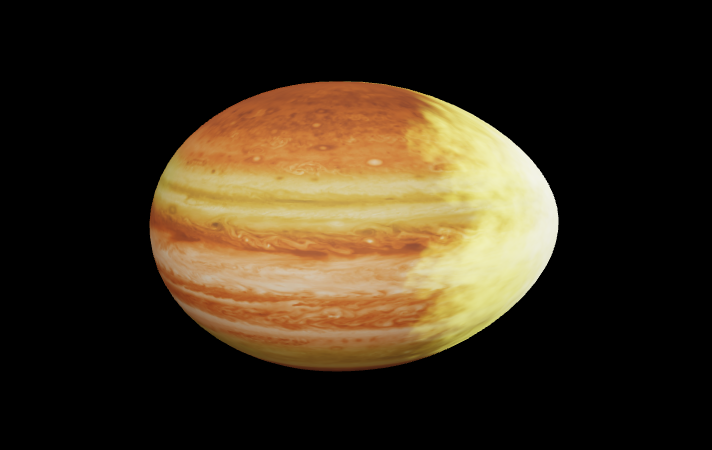
 NASA (Exoplanet Catalog artwork)
WASP-12b
An egg-shaped hot Jupiter being eaten by its star
Overview
WASP-12b is a hot Jupiter orbiting the star WASP-12, discovered in April of 2008, by the SuperWASP planetary transit survey. The planet takes only a little over one Earth day to orbit its star, in contrast to about 365.25 days for the Earth to orbit the Sun. Its distance from the star is only the Earth's distance from the Sun, with an eccentricity the same as Jupiter's. Consequently, it has one of the lowest densities for exoplanets. On December 3, 2013, scientists working with the Hubble Space Telescope (HST) reported detecting water in the atmosphere of the exoplanet. In July 2014, NASA announced finding very dry atmospheres on three exoplanets orbiting sun-like stars.
Source: Wikipedia
NASA: WASP-12 b is a gas giant exoplanet that orbits a F-type star. Its mass is 1.47 Jupiters, it takes 1.1 days to complete one orbit of its star, and is 0.0234 AU from its star. Its discovery was announced in 2008.
Why it matters
- Orbits so close that tides stretch it into an ellipsoid and strip gas into a disk around the star.
- Its orbit is measurably shrinking; it should spiral into the star within a few million years.
- Pitch black: it reflects less than 6% of incoming light, as hot as a red dwarf's surface.
NASA puts it this way: “The doomed planet WASP-12b is a hot Jupiter that orbits so close to its parent star, it's being torn apart. It takes this alien world only 1.1 days to completely circle its sun.”
Discovery & system
- Discovered
- 2008 · Transit · SuperWASP
- Discovery paper
- Hebb et al. 2009
- Host star
- WASP-12 · 6,265 K · 1.33 M☉
- System
- 1 known planet, 3 stars
The system
| World | Period | Distance | Radius | Mass | Temp. |
|---|---|---|---|---|---|
| WASP-12 b | 1.09 d | 0.023 AU | 1.96 R♃ | 1.47 M♃ | 2,601 K |
By the numbers
- Radius
- 1.96 R♃22 R⊕
- Mass
- 1.47 M♃467 M⊕
- Orbital period
- 1.09 d0 yr
- Distance from star
- 0.023 AU3.5 million km
- Eccentricity
- 0.045nearly circular
- Equilibrium temp.
- 2,601 K2,328 °C
- Starlight received
- 8,221 × Earth
- Distance from Earth
- 1,393 ly427.2 pc
- Density
- 0.27 g/cm³0.05 × Earth
Sources
Image: NASA (Exoplanet Catalog artwork) · NASA media: generally free of copyright · image page
Text: Wikipedia (CC BY-SA 4.0). Taglines and highlights are editorial.