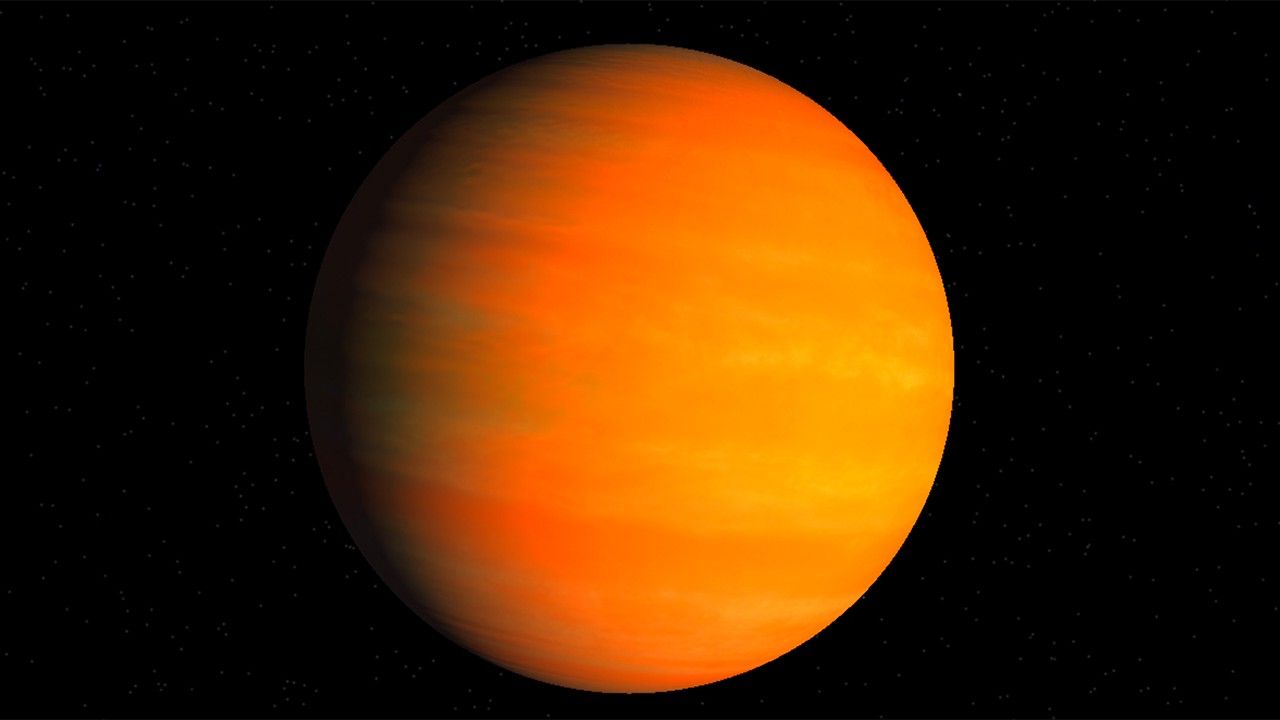
 NASA (Exoplanet Catalog artwork)
Kepler-16b
The real Tatooine — the first planet seen transiting two suns
Overview
Kepler-16b is a Saturn-sized exoplanet consisting of half gas and half rock and ice. It orbits a binary star, Kepler-16, with a period of 229 days. "It is the first confirmed, unambiguous example of a circumbinary planet – a planet orbiting not one, but two stars," said Josh Carter of the Center for Astrophysics | Harvard & Smithsonian, one of the discovery team.
Source: Wikipedia
NASA: Kepler-16 b is a gas giant exoplanet that orbits a K-type star. Its mass is 0.333 Jupiters, it takes 228.8 days to complete one orbit of its star, and is 0.7048 AU from its star. Its discovery was announced in 2011.
Why it matters
- Kepler watched it cross both stars of a binary in 2011, the first unambiguous circumbinary planet.
- Saturn-mass and cold, it circles the pair every 229 days.
- From its surface two suns would rise and set, with ever-changing double shadows.
NASA puts it this way: “Kepler-16b is a world where two suns set over the horizon instead of just one, the first Tatooine-like planet found in our galaxy.”
Discovery & system
- Discovered
- 2011 · Transit · Kepler
- Discovery paper
- Doyle et al. 2011
- Discoverers
- Kepler Space Telescope
- Host star
- Kepler-16 · 4,450 K · 0.69 M☉
- System
- 1 known planet, 2 stars (circumbinary)
The system
| World | Period | Distance | Radius | Mass | Temp. |
|---|---|---|---|---|---|
| Kepler-16 b | 228.8 d | 0.705 AU | 0.75 R♃ | 0.33 M♃ | 206 K |
By the numbers
- Radius
- 0.75 R♃8.4 R⊕
- Mass
- 0.33 M♃106 M⊕
- Orbital period
- 228.8 d0.63 yr
- Distance from star
- 0.705 AU105 million km
- Eccentricity
- 0.007nearly circular
- Equilibrium temp.
- 206 K-67 °C
- Starlight received
- 0.25 × Earth
- Distance from Earth
- 245 ly75.1 pc
- Density
- 0.96 g/cm³0.17 × Earth
Sources
Image: NASA (Exoplanet Catalog artwork) · NASA media: generally free of copyright · image page
Text: Wikipedia (CC BY-SA 4.0). Taglines and highlights are editorial.