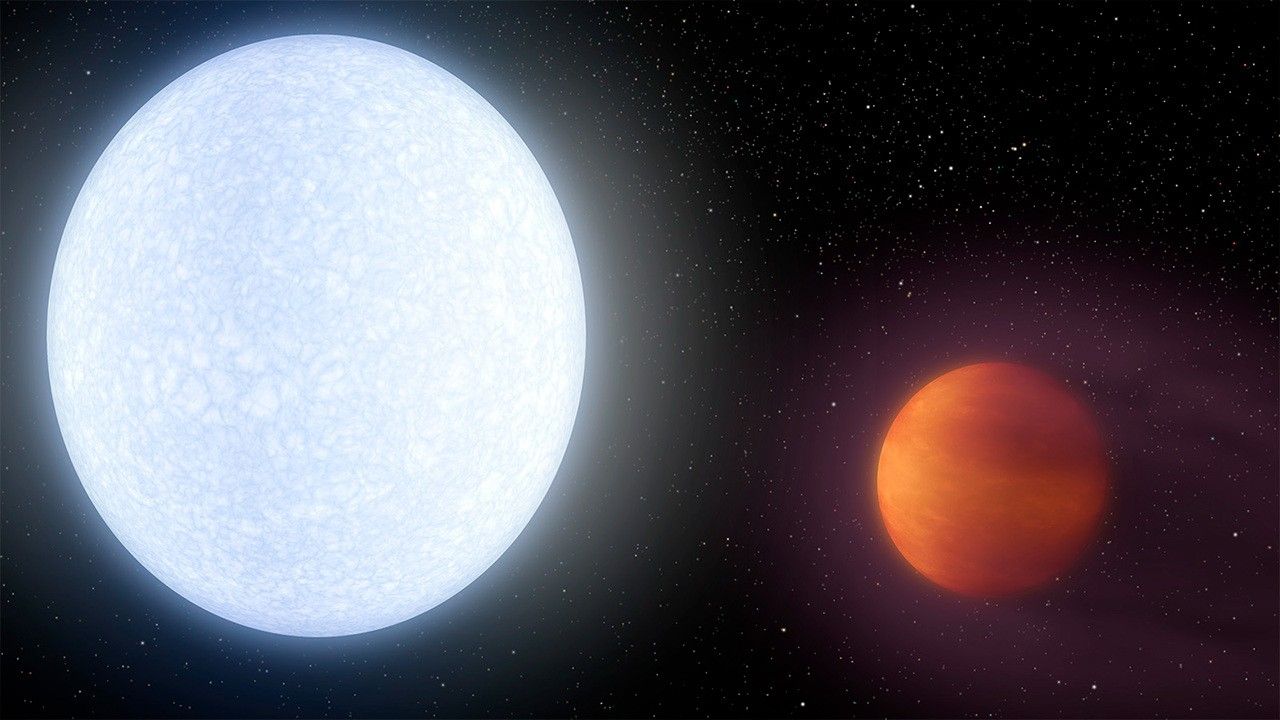
 NASA (Exoplanet Catalog artwork)
KELT-9b
The hottest known planet — hotter than many stars
Overview
KELT-9b, also designated HD 195689 b, is an exoplanet and ultra-hot Jupiter in a polar orbit around the late B-type/early A-type star KELT-9, located about 670 light-years from Earth. Detected using the Kilodegree Extremely Little Telescope, the discovery of KELT-9b was announced in 2016. As of October 2026, it is the hottest known exoplanet.
Source: Wikipedia
NASA: KELT-9 b is a gas giant exoplanet that orbits a A-type star. Its mass is 2.88 Jupiters, it takes 1.5 days to complete one orbit of its star, and is 0.03368 AU from its star. Its discovery was announced in 2017.
Why it matters
- Dayside temperature around 4,600 K, exceeding the surface of a typical red dwarf.
- Iron and titanium atoms were detected in its atmosphere in 2018, the first atomic metals found on an exoplanet.
- Orbits over the poles of a blue-white A-type star every 1.5 days.
NASA puts it this way: “KELT-9b is so hot that the heat tears molecules apart on the dayside.”
Discovery & system
- Discovered
- 2017 · Transit · KELT-North
- Discovery paper
- Gaudi et al. 2017
- Host star
- KELT-9 · A · 9,270 K · 2.32 M☉
- System
- 1 known planet, 2 stars
The system
| World | Period | Distance | Radius | Mass | Temp. |
|---|---|---|---|---|---|
| KELT-9 b | 1.48 d | 0.034 AU | 1.94 R♃ | 2.88 M♃ | 3,921 K |
By the numbers
- Radius
- 1.94 R♃21.7 R⊕
- Mass
- 2.88 M♃915 M⊕
- Orbital period
- 1.48 d0 yr
- Distance from star
- 0.034 AU5.04 million km
- Eccentricity
- 0nearly circular
- Equilibrium temp.
- 3,921 K3,648 °C
- Starlight received
- 44,900 × Earth
- Distance from Earth
- 667 ly204.5 pc
- Density
- 0.49 g/cm³0.09 × Earth
Sources
Image: NASA (Exoplanet Catalog artwork) · NASA media: generally free of copyright · image page
Text: Wikipedia (CC BY-SA 4.0). Taglines and highlights are editorial.