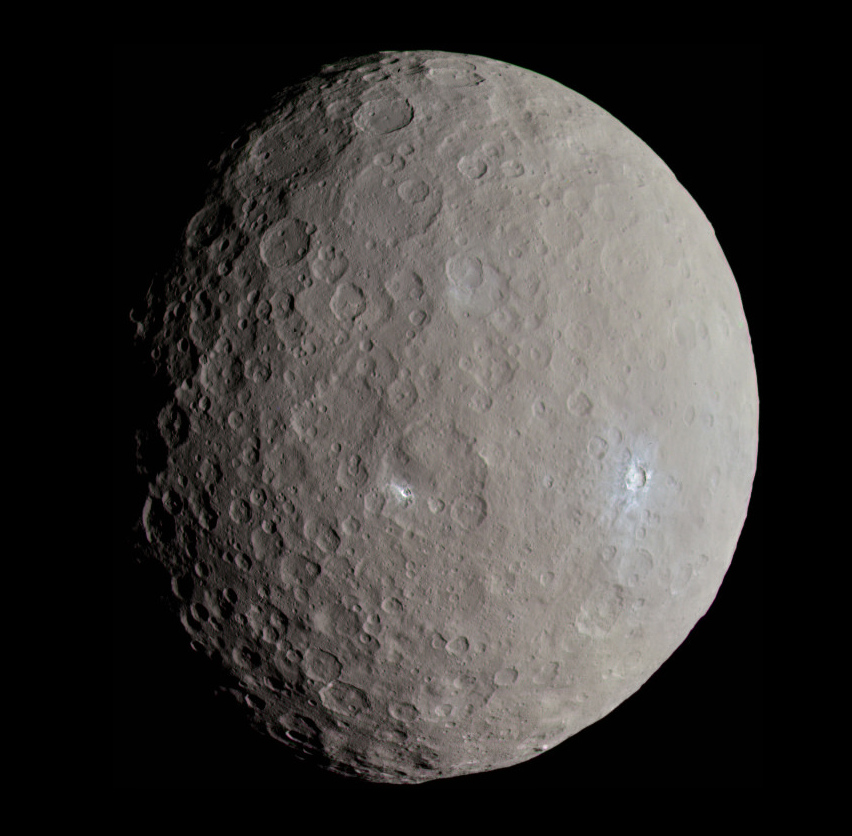
 Justin Cowart, Public domain
Ceres
The largest object in the asteroid belt, with salty bright spots and a muddy, briny interior
Overview
Ceres is a dwarf planet in the main asteroid belt between the orbits of Mars and Jupiter. It was the first object identified in the asteroid belt, discovered on 1 January 1801 by Giuseppe Piazzi at Palermo Astronomical Observatory in Sicily, and announced as a new planet. Ceres was later classified as an asteroid, and then more recently as the only confirmed dwarf planet within the asteroid belt, and the largest without a moon. It is also the only recognized dwarf planet in the solar system whose orbit lies within that of Neptune. In the minor planet numbering system, its designation is 1 Ceres or (1) Ceres.
Source: Wikipedia
Why it matters
- Discovered in 1801 and counted as a planet for decades before being reclassified as an asteroid, then a dwarf planet.
- Dawn (2015–2018) found bright sodium-carbonate deposits in Occator crater left by brine seeping from below.
- May still hold pockets of salty liquid water beneath its crust, making it an ocean-world candidate.
System
- Discovered
- 1801 · direct observation
- Discoverers
- Piazzi, G.
- Star
- Sun · G2 V · 5,772 K · 1 M☉
- System
- 8 known planets
Orbit in the Solar System
| World | Period | Distance | Radius | Mass | Temp. |
|---|---|---|---|---|---|
| Mercury | 88 d | 0.387 AU | 0.38 R⊕ | 0.055 M⊕ | 440 K |
| Venus | 224.7 d | 0.723 AU | 0.95 R⊕ | 0.82 M⊕ | 737 K |
| Earth | 365.2 d | 1 AU | 1 R⊕ | 1 M⊕ | 288 K |
| Mars | 687 d | 1.52 AU | 0.53 R⊕ | 0.11 M⊕ | 208 K |
| Ceres | 4.6 yr | 2.77 AU | 0.07 R⊕ | 0.94 ×10²¹ kg | — |
| Jupiter | 11.9 yr | 5.2 AU | 1 R♃ | 1 M♃ | 163 K |
| Saturn | 29.4 yr | 9.57 AU | 0.84 R♃ | 95.11 M⊕ | 133 K |
| Uranus | 83.7 yr | 19.16 AU | 0.36 R♃ | 14.53 M⊕ | 78 K |
| Neptune | 163.7 yr | 30.18 AU | 3.88 R⊕ | 17.08 M⊕ | 73 K |
| Pluto | 247.9 yr | 39.48 AU | 0.19 R⊕ | 13 ×10²¹ kg | 48 K |
| Haumea | 282 yr | 43.1 AU | 0.12 R⊕ | — | 50 K |
| Makemake | 306.6 yr | 45.6 AU | 0.11 R⊕ | 3.1 ×10²¹ kg | — |
| Eris | 561.3 yr | 67.9 AU | 0.18 R⊕ | 17 ×10²¹ kg | 43 K |
| Sedna | 12,676.2 yr | 544 AU | 0.08 R⊕ | — | 12 K |
By the numbers
- Radius
- 0.07 R⊕469 km
- Mass
- 0.94 ×10²¹ kg0 ×10²⁴ kg
- Orbital period
- 4.6 yr
- Distance from Sun
- 2.77 AU414 million km
- Eccentricity
- 0.08elliptical
- Density
- 2.16 g/cm³
Sources
Image: Justin Cowart, Public domain · Public domain · image page
Text: Wikipedia (CC BY-SA 4.0). Taglines and highlights are editorial.