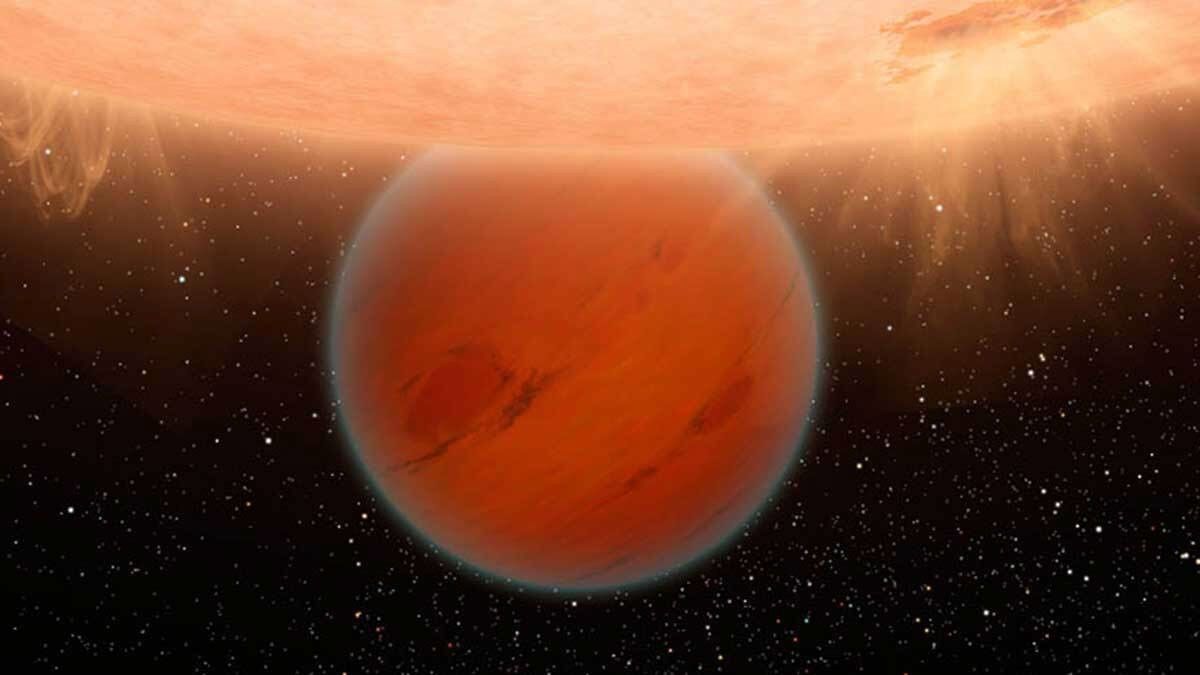
 NASA (Exoplanet Catalog artwork)
Gliese 436 b
Ein heißer Neptun, der eine riesige Wasserstoffwolke hinter sich herzieht
Überblick
Gliese 436 b ist ein Exoplanet, der den Roten Zwerg Gliese 436 umkreist. Er ist ein Eisriese und möglicherweise ein sogenannter „Hot Neptune“. Gliese 436 b wurde von Geoffrey Marcy und R. Paul Butler im Jahr 2004 durch Messung der Radialgeschwindigkeit des Sterns entdeckt.
Quelle: Wikipedia (de)
NASA: GJ 436 b is a Neptune-like exoplanet that orbits a M-type star. Its mass is 22.1 Earths, it takes 2.6 days to complete one orbit of its star, and is 0.0291 AU from its star. Its discovery was announced in 2004.
Warum sie zählt
- Hubble fand 2015 eine kometenartige Wasserstoffwolke von 50-facher Planetengröße, die hinter ihm herströmt.
- Umkreist die Pole seines Sterns auf einer unerwartet exzentrischen 2,6-Tage-Bahn.
- Seine Atmosphäre ist seltsam arm an Methan und reich an Kohlenmonoxid.
Die NASA formuliert es so: „A close exoplanet with a secret: a lack of methane on this hot world. GJ 436 b is a Neptune-sized exoplanet that orbits an M-type star. Its mass is 22.1 Earths,“
Entdeckung & System
- Entdeckt
- 2004 · Radial Velocity · W. M. Keck Observatory
- Entdeckungsarbeit
- Butler et al. 2004
- Entdecker
- Geoffrey Marcy
- Zentralstern
- GJ 436 · M2.5 V · 3.586 K · 0,47 M☉
- System
- 1 bekannter Planet
Das System
| Welt | Periode | Abstand | Radius | Masse | Temp. |
|---|---|---|---|---|---|
| GJ 436 b | 2,64 d | 0,029 AE | 0,37 R♃ | 22,1 M⊕ | 686 K |
In Zahlen
- Radius
- 0,37 R♃4,2 R⊕
- Masse
- 22,1 M⊕131,99 ×10²⁴ kg
- Umlaufzeit
- 2,64 d0,01 Jahre
- Abstand zum Stern
- 0,029 AE4,35 Mio. km
- Exzentrizität
- 0,138elliptisch
- Gleichgewichtstemp.
- 686 K413 °C
- Empfangenes Sternlicht
- 29 × Erde
- Entfernung zur Erde
- 31,8 Lj9,8 pc
- Dichte
- 1,8 g/cm³0,33 × Erde
Quellen
Bild: NASA (Exoplanet Catalog artwork) · NASA media: generally free of copyright · Bildseite
Text: Wikipedia (de) (CC BY-SA 4.0). Schlagzeilen und Highlights sind redaktionell.