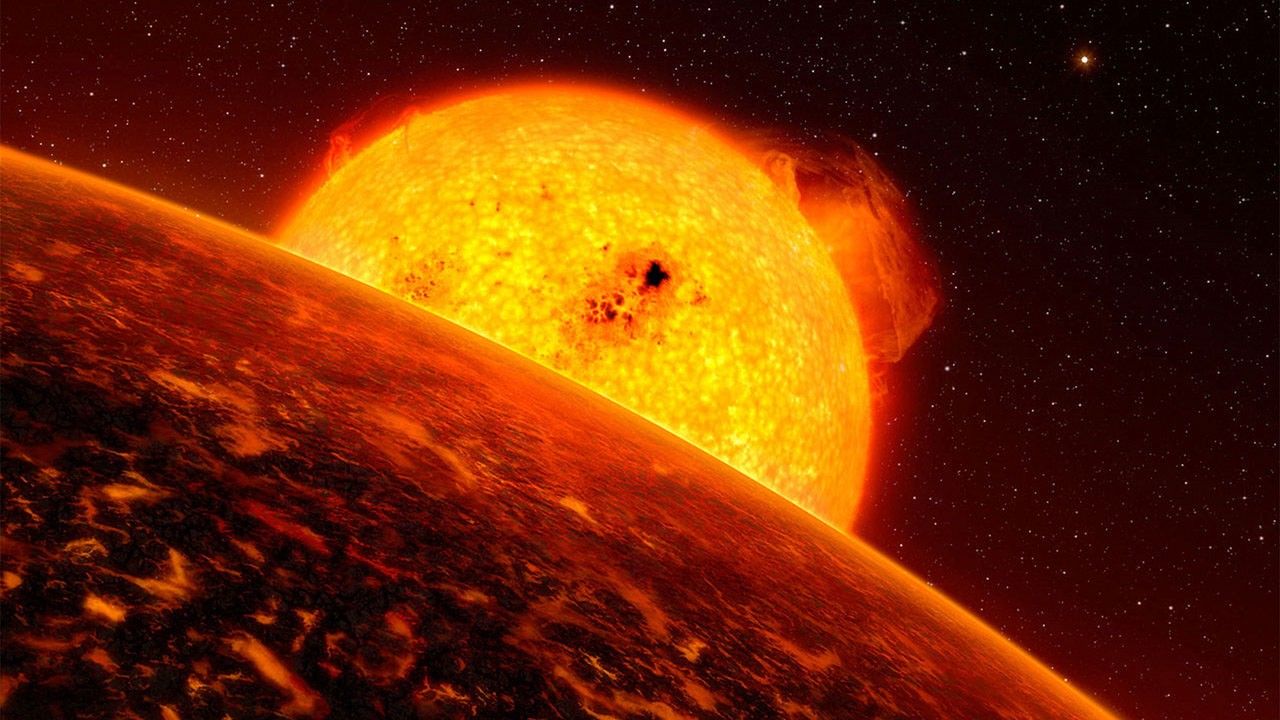
 NASA (Exoplanet Catalog artwork)
CoRoT-7b
Der erste bestätigte Gesteins-Exoplanet – eine Lavawelt mit 20-Stunden-Jahren
Überblick
CoRoT-7 b, früher CoRoT-Exo-7 b genannt, ist die Bezeichnung eines Exoplaneten im Sternbild Einhorn. Mit einem Durchmesser von etwa 20.000 Kilometer gehörte er bei seiner Entdeckung 2009 zu den kleinsten bekannten Exoplaneten. CoRoT-7 b ist ein Ultrakurzperiodischer Planet.
Quelle: Wikipedia (de)
NASA: CoRoT-7 b is a super Earth exoplanet that orbits a K-type star. Its mass is 4.07660518 Earths, it takes 0.9 days to complete one orbit of its star, and is 0.017016 AU from its star. Its discovery was announced in 2009.
Warum sie zählt
- 2009 vom französischen Weltraumteleskop CoRoT entdeckt; seine Dichte zeigte, dass er aus Gestein bestehen muss.
- Tagseitentemperaturen über 2 000 K halten vermutlich einen dauerhaften Magmaozean flüssig.
- Modelle legen nahe, dass seine Atmosphäre aus verdampftem Gestein besteht, das als Kieselregen zurückfällt.
Die NASA formuliert es so: „CoRoT-7 b is a super Earth exoplanet that orbits a K-type star. Its mass is 4.07661 Earths, it takes 0.9 days to complete one orbit of its star, and is 0.017016 AU from its star. Its discovery was announced in 2009.“
Entdeckung & System
- Entdeckt
- 2009 · Transit · CoRoT
- Entdeckungsarbeit
- Leger et al. 2009
- Zentralstern
- CoRoT-7 · G9 V · 5.275 K · 0,82 M☉
- System
- 3 bekannte Planeten
- Geschwister
- CoRoT-7 d, CoRoT-7 c
Das System
| Welt | Periode | Abstand | Radius | Masse | Temp. |
|---|---|---|---|---|---|
| CoRoT-7 b | 20,5 h | 0,017 AE | 1,68 R⊕ | 4,08 M⊕ | 1.756 K |
| CoRoT-7 c | 3,7 d | 0,046 AE | 2,83 R⊕ | 8,4 M⊕ | 1.099 K |
| CoRoT-7 d | 8,97 d | 0,079 AE | 0,38 R♃ | 17,14 M⊕ | — |
In Zahlen
- Radius
- 1,68 R⊕10.712 km
- Masse
- 4,08 M⊕24,35 ×10²⁴ kg
- Umlaufzeit
- 20,5 h
- Abstand zum Stern
- 0,017 AE2,55 Mio. km
- Exzentrizität
- 0nahezu kreisförmig
- Gleichgewichtstemp.
- 1.756 K1.483 °C
- Empfangenes Sternlicht
- 1.774 × Erde
- Entfernung zur Erde
- 522 Lj159,9 pc
- Dichte
- 9,36 g/cm³1,7 × Erde
Quellen
Bild: NASA (Exoplanet Catalog artwork) · NASA media: generally free of copyright · Bildseite
Text: Wikipedia (de) (CC BY-SA 4.0). Schlagzeilen und Highlights sind redaktionell.